3 Lent.A.26
John 4:5-42
The Rev. Melanie McCarley
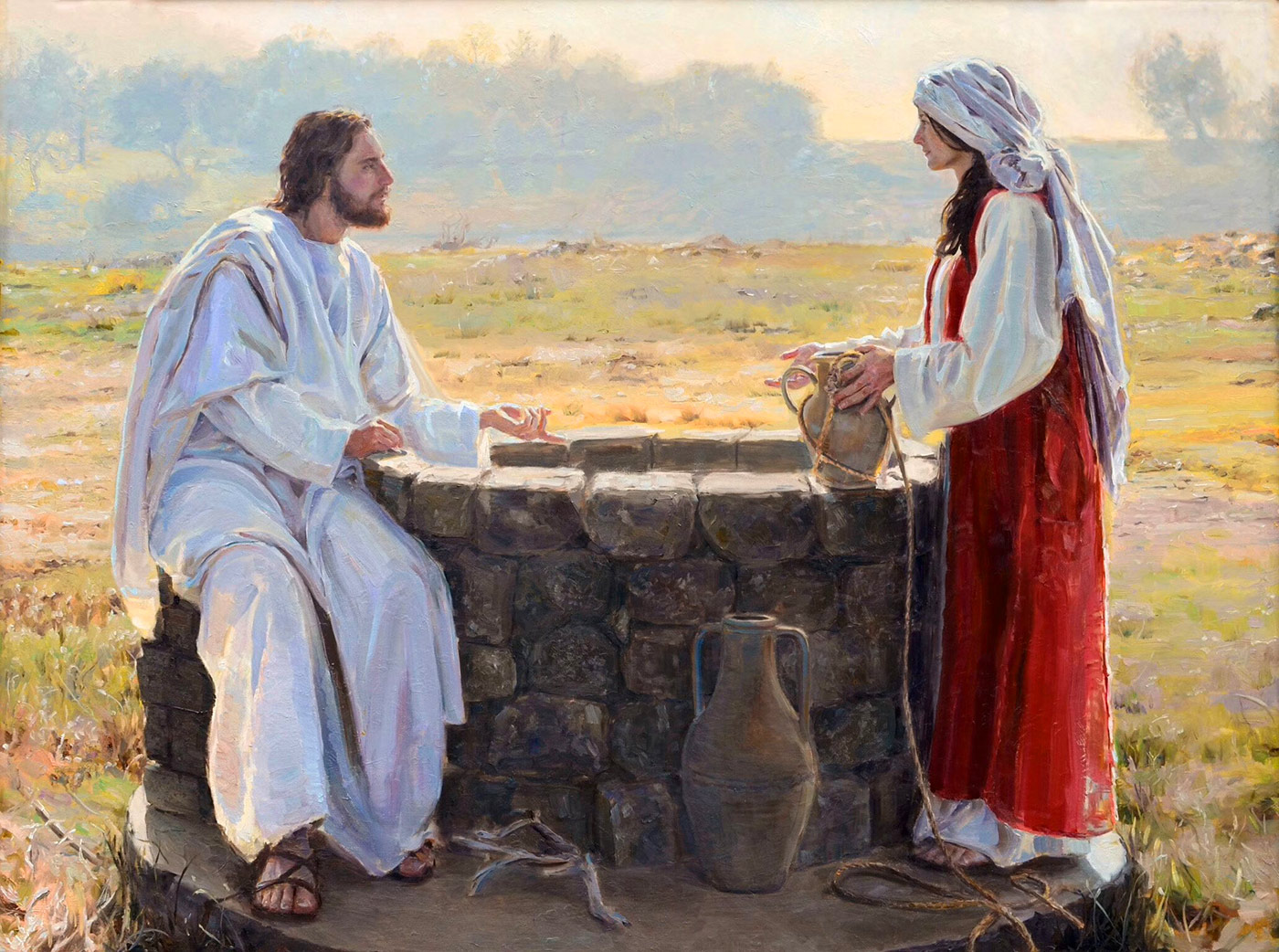
Well…that was quite a long gospel lesson, wasn’t it. We just listened to the longest conversation that Jesus has with anyone in the Gospels. Last week we read the story of Nicodemus, a Jewish leader, who comes to Jesus under the cover of darkness to talk with him about his ministry. That conversation consisted of three brief exchanges. In all, Nicodemus speaks about fifty words, and Jesus issues a short sermon. But here, in today’s lesson, the Samaritan woman and Jesus discuss everything from theological differences between Samaritans and Jews to the woman’s personal history all under the bright light of the noontime sun.
I believe people long for good conversations. It matters for theology—and it is essential for faith. It’s also becoming comparatively rare in our society which reduces so many discussions to debates and soundbites which essentially come down to “I’m right and you’re wrong.” A good conversation is emblematic of what a true relationship looks like—there is mutuality, reciprocity and regard. So, let’s take a closer look at the conversation Jesus has with the woman of Samaria.
Theologian Karoline Lewis points out that the conversation begins with mutual vulnerability. Jesus is thirsty and the woman at the well needs the kind of water that only Jesus can provide. So, here is a hint for us as to where truthful conversations must start—from a place of reciprocal vulnerability where each person risks being known and seen—and maybe, even changed.
Questions are critical. Not, mind you—leading questions, designed to take us to a particular conclusion; nor questions only asked to feign manners “Some weather we’re having today, don’t cha think?” Instead, questions that communicate curiosity, an interest in the other, a longing for information and understanding. That woman at the well, she was chock full of questions—thoughtful questions, questions that mattered to her and led Jesus to reveal to her who he really is. So, perhaps this tells us something important about God. God wants us to ask questions—because it’s by asking questions that our relationship with the Lord is strengthened.
Now, about that woman. I don’t know about you, but what I think captivates most people when hearing this exchange is the part about the five husbands. We get there—and, well…we just stop! In fact, many of us were taught that this story, of the Samaritan woman, was about sin. She had five marriages after all, and was currently living with someone who was not her husband. She was visiting the well at noon—not in the morning when most people would have stopped by. Sin is what most people think—at least where I come from. But if you pause and look again at the conversation you’ll notice that the topic of sin never enters the picture. In fact, it’s never mentioned, not at all. This is not a story about forgiveness. What Jesus and the Samaritan woman talk about is ethnic difference, theological difference, the purpose and meaning of life, and how to live when your life becomes illuminated by the truth. Hmmm.
This conversation between Jesus and the Samaritan woman at the well calls into question our modern-day reticence to talk with anyone who differs from us in any way possible. Celeste Headlee reports: “I’ve been told many times in recent years that there are some people “you just can’t talk to.” One person told me that she can’t speak to anyone who won’t acknowledge the existence of institutional racism. Another said that if someone he knew supported a particular presidential candidate, then “we have nothing in common and nothing to say to each other.”
Which makes the following story all the more remarkable: “In the 1960s, an African-American woman named Xenona Clayton was appointed to oversee a neighborhood improvement program in Atlanta. Ms. Clayton was a good friend of Coretta Scott King and had worked closely with Dr. King. When she took the job, she was warned that one of her neighborhood captains was a grand dragon in the Georgia Realm of the United Klans of America, Knits of the Ku Klux Klan. His name was Calvin Craig.
Despite his devotion to white supremacy, Craig found that he enjoyed talking to the brilliant black woman from Muskogee, Oklahoma. Over the course of the next year, he came to her office to chat almost every day. As she recalled in a 2011 article in Atlanta Magazine, Ms. Clayton asked him, “Why do you keep coming here? You and I don’t agree on anything.” He told her she was just fun to talk with.
Those conversations between Ms. Clayton and Craig help to explain the stunning development that ensued: In April of 1968, Craig held a press conference to announce that he was leaving the KKK. He declared that he would now dedicate his life to building a nation in which “black men and white men can stand shoulder to shoulder in a united America.”
That is the power of conversation between people who are willing to listen to each other and learn, and it is important to keep in mind when people claim that they “just can’t” talk to someone else because their opinions are too opposed or offensive.
In Eastern Orthodox tradition, the Samaritan woman at the well comes to be called “Photine,” “The illuminated (or enlightened) one. She is celebrated as a person who, after meeting Jesus and telling her neighbors about her discovery, travelled around the Mediterranean world preaching the gospel. Some parts of the tradition say that she ended up in Rome, preached to Emperor Nero, and died there as a martyr. Lost in our western tradition is the fact that this woman was called the first evangelist and “equal to the apostles.”
In the world in which this woman, and Jesus, lived the basic human need for water was entangled in a morass of social, political and even theological conditions. Who could drink from what well. Who had access to clean water and who did not. Who could offer water to whom and who could accept.
What Jesus offered this woman was freedom from these conditions. In essence, what our Savior says to her is this—these distinctions, between Jew and Samaritan, between male and female—they are meaningless. He says: “The hour is coming when you will worship the Father neither on this mountain nor in Jerusalem.” In other words, there will be a time in which the boundaries which divide us will crumble. That woman in Samaria joyfully crossed the boundaries, bringing Good News to all in her community. May each of us do the same. In Jesus’ name. Amen.