Last Epiphany.A.26
Matthew 17:1-9
The Rev. Melanie L. McCarley
Several years ago, on a highway somewhere between Maryland and West Virginia, I encountered a problem. I had begun my drive to a diocesan meeting in the gray dawn of early morning. Before getting in my car, I noticed it was foggy outside. I assumed, given the forecast, that it would burn off, and soon the day would turn sunny. I turned on my headlights and headed out. Miled passed. Instead of clearing, as I had expected, the fog increased in density. “Goodness, I thought to myself, it’s really foggy out there.” I turned on the windshield wipers. Nothing changed. I slowed down, but couldn’t help but notice cars zooming past me seemingly without a care in the world. “In this fog?” I thought to myself: “That’s madness! They’re bound to get in a wreck.” I moved to the slower lane and more miles passed. By now I was squinting and peering through the windshield with some degree of difficulty. After a few more mile markers had gone by I began considering pulling over for by now I could barely see. And yet—I still perceived cars zipping along, passing me at every chance. “How can they drive like that?” I wondered to myself. Until finally, at long last, I looked a bit more closely at my windshield, and looked again. Understanding dawned, and I reached over to turn on the defroster. The condensation on the inside of my windshield cleared—and suddenly, the world about me became gloriously clear, the sun shining with resplendent light. It was, as I think about it now, an absolutely beautiful morning. The problem I was encountering wasn’t the fog—it was with me.
This, I believe, is the state of humanity in the world—most of the time. We lope about in a haze of our own making, convinced that what we are able to see is all that is there—and that beyond our own eyes and minds, nothing that is real could possibly exist.
But perhaps, if we are honest with ourselves, we might consider that there are moments—brief, shining, glorious flashes of insight that allow us a peek beyond the veil. Fleeting impressions that ourselves and this world which we inhabit for a brief span of time is not all there is.
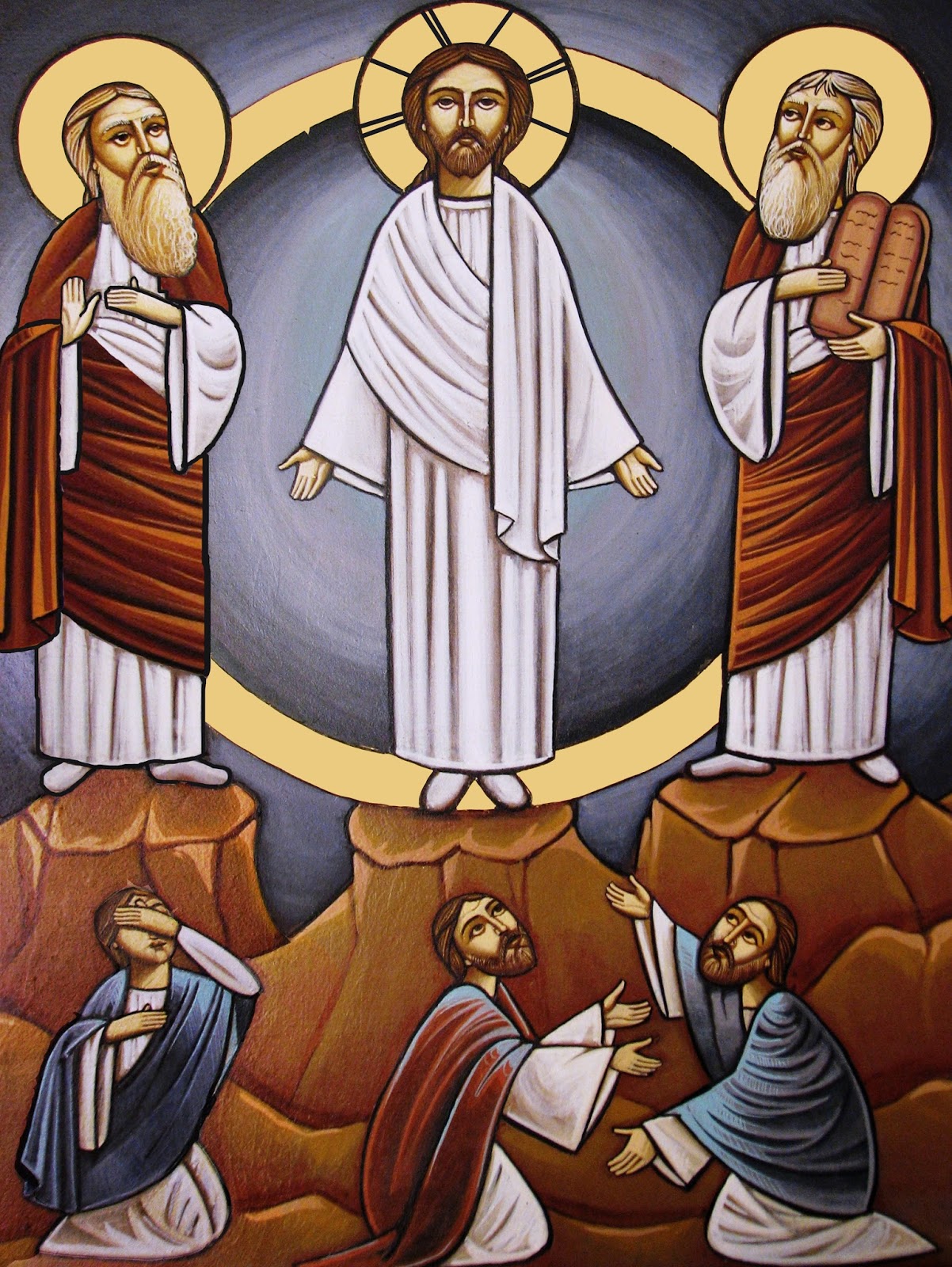
This is how I conceive of the event known to us as the Transfiguration, which we encounter this morning in the Gospel of Matthew. Today is the Last Sunday after the Epiphany—perfect timing, if you think about it, for a grand unveiling. After all, the word “epiphany” means disclosure, manifestation or appearance. And certainly, the Transfiguration of Jesus, complete with blinding light, a heavenly voice and visions of the great prophets Moses and Elijah does not fail to disappoint. It is a fitting end to the season of Light—and a wonderful vision for us to carry with us as we enter the barren wilderness region of the season of Lent.
In the lesson for today Jesus takes with him Peter and James and John and leads them up a high mountain, by themselves. And once there, he is transfigured before them, his face, shining like the sun, and his clothes becoming a rare, dazzling white. Now, he is joined by Moses and Elijah. And as Peter is busy making a confused hash of things—babbling about making them booths to celebrate the Jewish feast of Sukkot, a bright cloud overshadows them and from the cloud a voice speaks, saying, “This is my Son, the Beloved; with him I am well pleased; listen to him!” And…boom…the disciples fall to the ground stunned, and mercifully silent, consumed with fear. Jesus comes to them, touches them and says, “Get up and do not be afraid.” And when they look up, they see no one except Jesus himself, alone. And as they descend the holy mountain, Jesus orders them to be silent, and to tell no one about the vision until after the Son of Man has been raised from the dead.”
Why the silence? For that matter, why not make the Transfiguration a public event—then everyone could be certain as to what they saw? Why not combine this moment with the feeding of the 5,000, making it something of a double-feature for the populace. Certainly that would make the point as to who Jesus is. But what we have here is a beautiful vision—looking more like a private screening rather than a spectacle designed to convince the nations that the Lord, Jesus is the Messiah.
But think again. Would three people witnessing this moment or 5,000, make any difference to you? I doubt it. We live in a world where we are certain of so little—less now than ever before. All day long we are assaulted by words, couched as fact, some spoken by political leaders, others conjured by AI, Social Media and Conspiracy Theorists…who knows what to believe, if anything at all. How can we see the truth of God and this world clearly while surrounded by a fog of deceit. Is the hope of perceiving truth even possible?
The novelist Marilynne Robinson has an insight that might prove helpful. She reminds us that we are surrounded by glory all the time in God’s good creation. It’s just that most of the time we cannot see it. But then…there is the wonder of lawn sprinklers—or perhaps (since it is cold out there) icicles. Because on clear days sprinklers shoot forth water droplets into the sunlight and when this happens and the sunlight refracts through the water, we realize that every single water droplet is really a cathedral, a jewel, a luminous rainbow of God’s own glory that suffuses us at all times, though, in ordinary moments, we cannot perceive it. We glimpse this glory too rarely but it’s always there.
Jesus on the mountaintop is like the water in a sprinkler (or light refracted through a crystal…or an icicle). It’s not that he changed into something he was not ordinarily—it’s just that he turned (just so) into God’s light, and the glory inherent in him shone with peculiar radiance!
Apprehending the holy, glimpsing the truth of God in our world, doesn’t take a seminary degree, years of studying the Bible or achieving deep meditation; though all of these things can be good and helpful, in and of themselves.
Perhaps, what it takes—more than anything else—is a degree of humility. I think back to my experience driving on the highway. I believed (In fact, I was firmly convinced) that the fog I was seeing was in the world, outside of me and my vehicle. In truth, that fog was real enough, it was just located on the inside of my windshield, masking the reality outside. The Transfiguration is an invitation for us to consider that what we see isn’t all there is. Perhaps, past the condensation clouding the vision of our hearts and minds, there is glory shining close beyond, just waiting for us to truly look, and see. In Jesus’ name. Amen.