3 Easter.A.26
Luke 24:13-35
The Rev. Melanie McCarley
The Danish philosopher and theologian Soren Kierkegaard wrote a brief but poignant prayer for clarity. “Lord! Give us weak eyes for things that do not matter. And eyes full of clarity in all your truth.” Written in the nineteenth century, its words are perennially relevant. “Lord! Give us weak eyes for things that do not matter. And eyes full of clarity in all your truth.” This prayer seems almost tailor made for the Gospel lesson for today as well as the contemporary world in which we live.
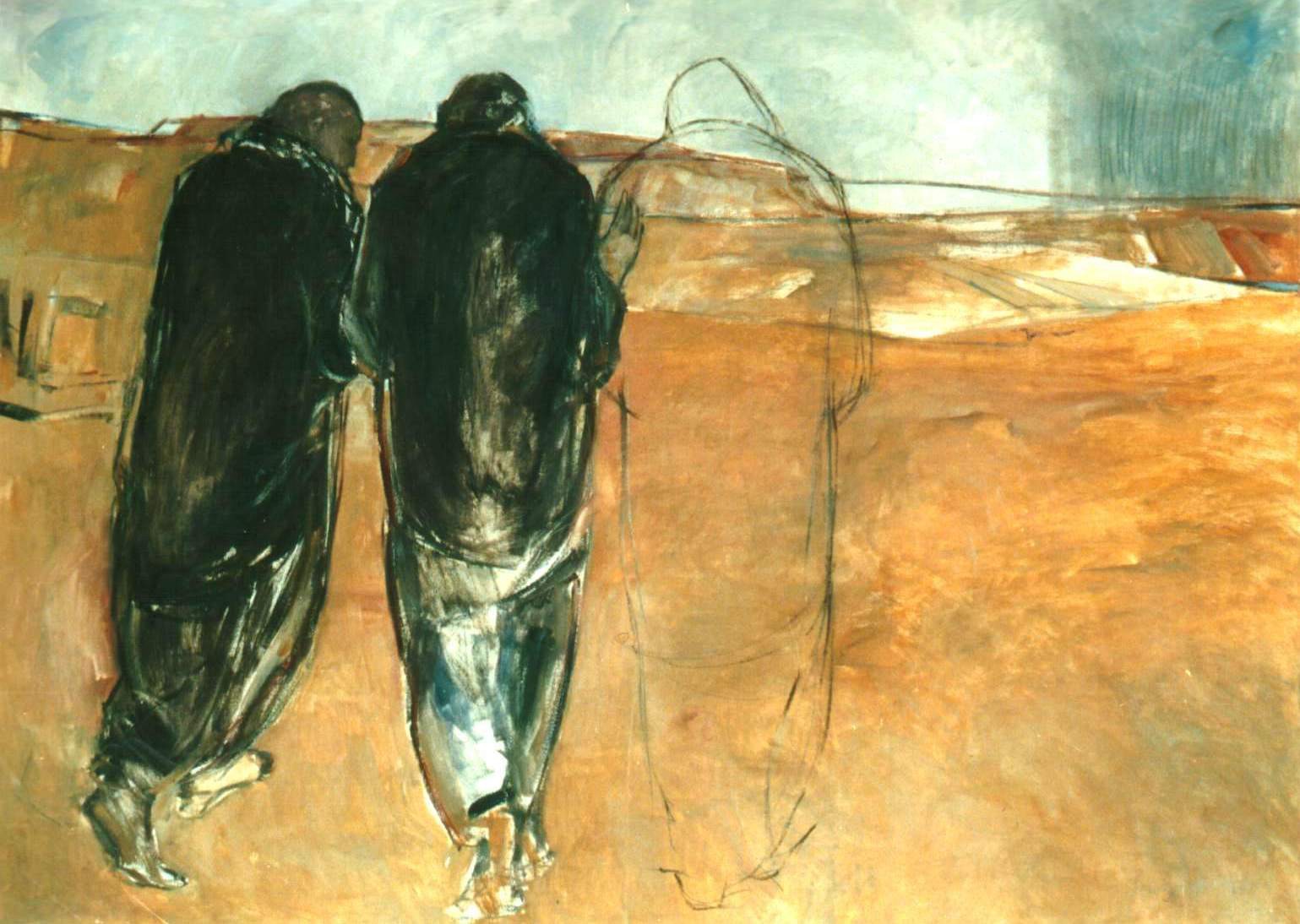
In today’s story, known to us as “The Road to Emmaus” we encounter Cleopas and his friend, the two of them, disciples of Jesus, are walking toward the city of Emmaus, some seven miles from Jerusalem. By way of interest—biblical scholars aren’t certain where Emmaus was located. Stay tuned for this week’s mid-week constant contact for more information. These two disciples, they are absorbed in talking about the events leading up to and including the crucifixion of Jesus as well as the odd story of the resurrection. Bear in mind that this story occurs on the day of the resurrection. Earlier this same morning the women encountered the empty tomb and brought their news to the disciples. Cleopas and his friend are individuals whose feet are firmly rooted in the cares and concerns of this world—they are not staying in Jerusalem to see what happens. They are leaving—dare I say, fleeing. Their hearts are heavy, and their vision is muddied. In fact, so consumed by their grief and disappointed hopes are they, that they don’t notice that Jesus has come to walk beside them. Remarkable!
Commentators have offered every imaginable explanation for the blindness of these two disciples. Perhaps grief clouded their perception. Perhaps the resurrected Christ appeared altered in some mysterious way. Perhaps they were walking west from Jerusalem toward Emmaus at sundown, with the light low in their eyes, squinting into the glare and simply were unable to make out his face. For whatever the reason (and in my mind, it matters not what the reason was), they failed to perceive Jesus walking alongside them. They were oblivious to the Lord.
In fact, (and this is striking), they continued to be blind to who Jesus was even when he was interpreting scripture for them. Now, they heard the right teaching—in fact, they would later say that as they listened their hearts were “burning within them.” Yet, apparently, the conversation was still not enough for them to see Jesus.
As the story continues, we discover that Jesus becomes recognizable only when the two disciples perform an act of hospitality. We read: “As they came near the village to which they were going, he walked ahead as if he were going on. But they urged him strongly, saying, “Stay with us, because it is almost evening and the day is now nearly over.” So Jesus goes in to stay with them. And there, in welcome, generosity, and kindness to one who appears to be merely a traveler—their eyes are opened.
Here is what’s important: the sequence of events. Christ is not recognized through argument, doctrine, or ideological certainty, but through practices St. Paul would later refer to as the fruits of the Spirit: love, joy, peace, patience, kindness, generosity, gentleness. (“Come, sit down, rest and eat, the day is nearly over). Recognition comes when the disciples inhabit those virtues. They do not truly see Jesus until they begin acting like him. Hear that again: They do not recognize Jesus until they begin acting like him. Hospitality opens the door for recognition as to who is in their midst.
Herein is a lesson for us. If you want to see Jesus, if you want to encounter the risen Lord—odds are good that you are not going to get there solely through reason and logic, debate and even discourse. You will get there only when you begin to act like him. I’m a great fan of reading church history, studying the Bible and delving into odd nooks and crannies of church lore—but if you were to ask me the about the greatest influence bringing me to a life of faith, it would not be words—it would be people. People through whose actions I have encountered Christ. If you want to truly see and know the risen Lord, you must begin to act like him. In this respect, the Sermon on the Mount can be our guide—where Jesus blesses the meek, the merciful and the peacemakers.
This is becoming a more challenging concept for us to grasp in our nation today; a time in which a Nationalist form of Christianity is being promulgated by those in power. This is a version of Christianity in which the virtues of St. Paul would be almost unrecognizable: love, joy, peace, patience, kindness, generosity and gentleness.
Christian Nationalists, they don’t uphold these virtues. They mock them. From a Christian Nationalist perspective, religion exists primarily as a tool to support a hierarchy and a particular political perspective rather than the living God. This past week we have witnessed the highest levels of our government attempting to leverage religion for political purposes—a rather remarkable move when you consider that our Savior was executed for the political crime of treason—of attempting to overthrow the Roman government.
How, in a world where the truth of the Gospel is being bludgeoned into something unrecognizable, are we followers of Jesus able to maintain a vision of our Savior with clarity—so that we might know Him and follow Him with a reasonable expectation that we are doing the right thing? The answer, I believe, is twofold, and it’s found in the Gospel story appointed for this, the third week of Easter: First, familiarize yourself with the scriptures. That’s what Jesus did with Cleopas and his companion. For the rest of us, just read the Gospels. If all four seem too much, just focus on one or two. One of the most wonderful things about Christianity is that, at its heart, the Good News is very simple—and it is available to everyone. Think of your faith as your journey to Emmaus with Jesus at your side. Ask our Lord to illuminate your heart with the truth.
Second, participate in the Sacraments—break bread with your neighbors, be a part of Christian fellowship and community. Don’t just study your faith—live it. What’s more, look for examples in your church and your community of those to follow—the people whose lives seem to be in sync with the Jesus of the Bible. We can, I believe, discern truth from falsehood, but only if we are willing to put in the effort to approach our faith with discernment and with humility.
The earliest Christians were referred to as People of the Way—people on a journey. The same remains true today. Each of us is walking our own road to Emmaus—and Jesus, he is at our side. With grace and humility, may we see him as he is—and may we be the people he wishes for us to become. In Jesus’ name. Amen.