Last Pentecost.C.25
Colossians 1:11-20; Luke 23:33-43
Melanie L. McCarley
In the Letter to the Colossians, we hear these words about the person of Jesus: “He is the image of the invisible God, the firstborn of all creation; for in him all things in heaven and on earth were created, things visible and invisible, …—all things have been created through him and for him. He himself is before all things, and in him all things hold together. He is the head of the body, the church; he is the beginning, the firstborn from the dead, so that he might come to have first place in everything. For in him all the fullness of God was pleased to dwell, and through him God was pleased to reconcile to himself all things, whether on earth or in heaven, by making peace through the blood of his cross.”
The readings this week invite us to explore the traditional and deeply discomforting theme of Christ the King. Here in the United States, contemplation of Christ as King is particularly problematic. After all, we’re the country of revolutionaries who overthrew King George in favor of a representative democracy. From this perspective, kingship is largely regarded with suspicion, if not distaste. Indeed, we can walk the streets of our town and behold yard signs proclaiming “No Kings.” in a reference to our present political climate. Suffice it to say, kingship is a problem not just for some, but for a lot of people. If you look at new worship resources you will see that references to Jesus as King and Lord have been judiciously replaced with “God be with you.” as a nod to more inclusive language. Where does this leave us on “Christ the King Sunday?” Has Christ the King somehow become irrelevant? Obsolete? Embarrassing, even? Would we be better off emphasizing “Christ the Teacher” or “Christ the Community Organizer?”
If we are to begin to make any sense of Christ as King, we must first look to the readings appointed for today. The prophet Jeremiah speaks of a promised king who shall execute justice and righteousness. Then there is the Letter to Colossians where we are told that Christ, who exists beyond time, is the one in whom all things hold together in heaven and on earth. Finally there is Luke’s account of the crucifixion of Jesus—and it is here that our lectionary gives us the last and most vivid picture as to who Jesus is as Christ the King. Ours is a crucified King.
What is striking in the lessons for today—each of which centers around the theme of kingship—is not what we see; but what we don’t see. In these readings there is no path to glory that somehow manages to sidestep humility, surrender and sacrificial love. Here we find no evidence of permission granted to seek prosperity at the expense of another’s suffering; nor is there tolerance for the belief that holy ends somehow justify debased means. In this Kingdom, truth matters; as does compassion, empathy and sacrificial love. Here there is no evidence that the Church is to thrive and grow only if it aligns itself with political power. Where does this leave us? I think it leaves us with a king who makes us uncomfortable. (PAUSE) But there is also this: In these readings we discover a King who is steadfast and gracious—who brooks no tolerance with either sin or death—defeating them both. This is a King who wipes away our tears—a King whose final judgement is found in peace and love and an overarching banner of grace spanning the whole. If we look closer, perhaps we might find that the picture we are left with is that of a King who is indeed worthy of our worship, honor, glory and praise.
A “Christ the Teacher” can give us direction as to how to live our lives, but has no bearing upon the real sticking points of humanity—namely sin and death. And a “Christ the Community Organizer” shows the importance of calling people together to achieve great and important things—but even here; the emphasis isn’t upon Christ, so much as upon us. And, let’s face it—humanity, on its own, lacks a degree of grace that only the Godhead can bestow. Following this Christ might lead us to where there is food to share with our neighbors—and as important as this is (and it is!), it is not the same as the bread of heaven which promises everlasting life. In the end, only a Christ who is both human as well as divine can offer us a God worthy of the name King.
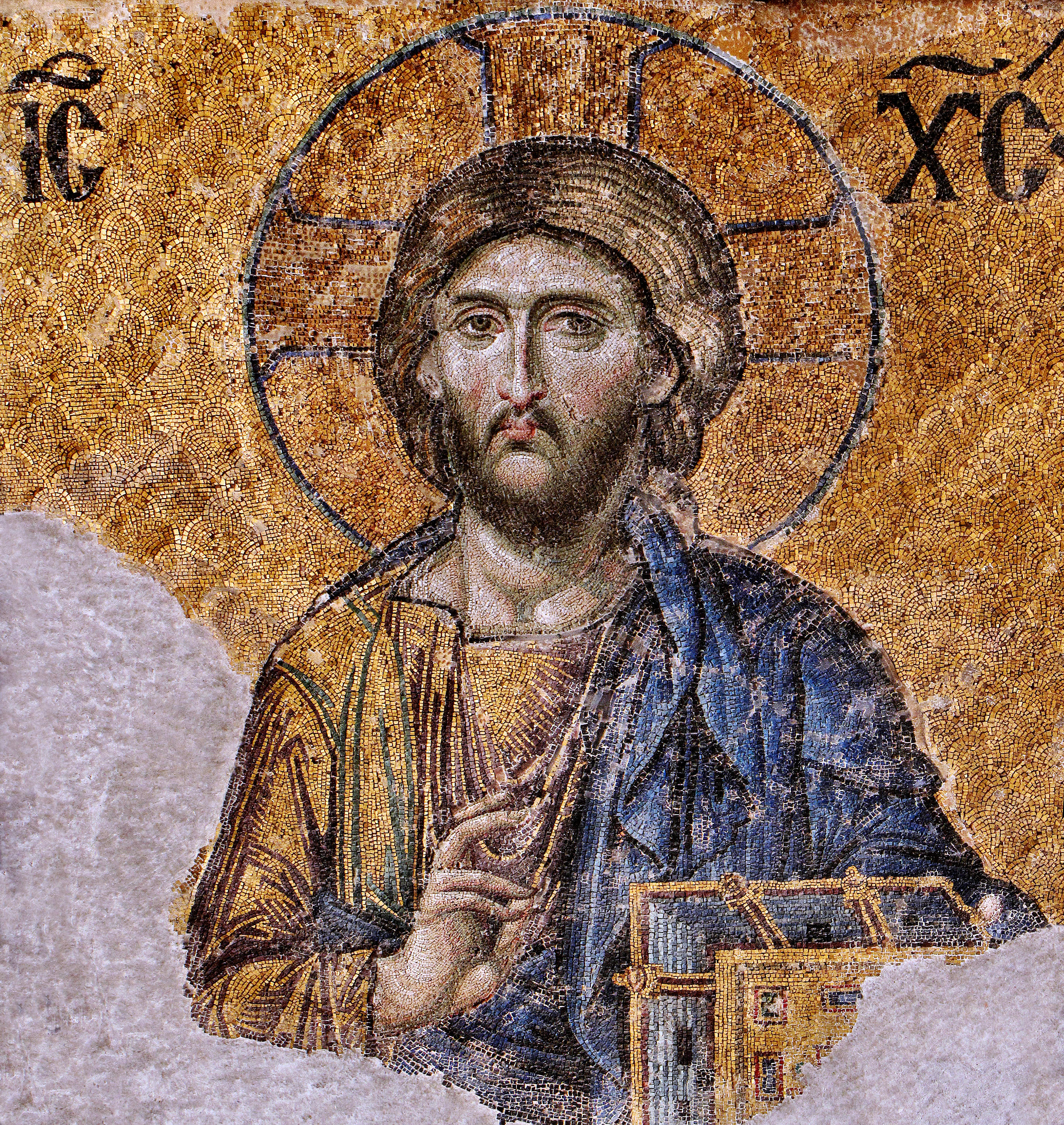
Bearing this in mind, I’d like to draw your attention to the picture on the front of today’s program. This is an image of Christ Pantocrator—which can be translated as “Christ Almighty” or “Christ all-powerful” or “Christ Ruler of All”. This is the words found in the Letter to the Colossians , with which I began today’s sermon made visible. This particular icon is found in the Hagia Sophia in Istanbul; however, you can find similar representations of Christ throughout the world. Here is what to notice about these representations of Christ Pantocrator.
Episcopal priest and icon writer, Mary Green says that we should look at the nimbus first—that is the disk surrounding Christ’s head. The nimbus encircles a cross. Christ’s holiness is understood through the cross. This is where Jesus Christ’s human and divine natures come together. There is no victory without the cross. In the top left and top right corners are Greek letters. These are the first and last letters of Jesus’ earthy name (Iesous) and the first and last letters of his divine name (Christos). Christos is the Greek translation of the Hebrew word Messiah, meaning Anointed One. The clothing Christ is wearing is important as well. The gold inner garment reflects Christ’s divinity; the blue cloak represents the color of humanity. It is the outer garment that Christ “puts on” when he comes to earth as the Word made Flesh.
In Christ’s left hand you can see that he holds a book, indicating his role as logos, the Word of God which speaks all things into being. He raises his right hand in blessing. In this portrayal of Christ Pantocrator there is power and stillness suffused in a glorious, golden light. This is a portrait of the risen and ascended Christ who, in the Letter to the Colossians “holds all things together—humanity and divinity, the world’s peace and its justice. Notice how Jesus faces us straight on, with broad shoulders, a regal bearing and a smooth, serene brow. He has conquered death, sin and hell. In this icon, he is our Sovereign: all things are under his feet—all things are held together as one.
Contemplating Christ leads to knowing Christ, and finally to worshipping him. Today is the last Sunday of the liturgical year—a time in which we come face to face with the Christ who is God of both heaven and earth. Today is the triumphal conclusion of the liturgical year. The child, whose birth we herald in the season of Advent has come full circle to the Christ who is the King eternal—a king who is worthy of our worship and our praise. In Jesus’ name. Amen.