2 Lent.A.26
Genesis 12:1-4a
The Rev. Melanie McCarley
I have never given much thought about Abraham, the patriarch of our faith, as having had a father, but, of course, he did. We even know his name, Terah. Terah, we are told, had plans to go to the land of Canaan. And to this end, he took with him his son Abram and his wife Sarai, as well as his grandson Lot. The family got as far as Haran and there they stopped and stayed. This is about all we know about Abram prior to his astonishing call from God to “Go from your country and your kindred and your father’s house to the land that I will show you.” And, remarkably, on nothing more than this, Abram goes.
I don’t know about you, but those are pretty vague directions—somewhat along the lines of “Head east until you no longer see the horizon.” But Abram, man of great faith that he was, packs up his wife Sarai, his cattle, his tents and goods and goes.
What type of person travels without knowing where they are going—with no destination in mind—just a vague promise? It reminds me of when Phil and I were about to get married. Phil had taken a job at Riley Children’s Hospital in Indianapolis, and we were to begin our married life in the Midwest. I am a child of the east coast. I had been everywhere from Maine to Florida, but until that time in my life I had never ventured west of the comforting range of the Blue Ridge Mountains. Knowing my life was about to change, I decided to do research. I went to the library (this was long before the internet). I looked, and looked some more—with growing consternation. There were no books with pictures of Indiana. None. With no way for me to know what this unknown land was supposed to look like I asked Phil, who was less than helpful: “Oh, it looks like a midwestern place.” He replied. “Do they have trees? Hills? Are there tumbleweeds?” A few weeks later we set out to find a home. We rolled into Indianapolis in an un-airconditioned 1979 Monte Carlo on a sweltering August day. My first view of the city was less than inspiring. A mushroom-like cloud of smog hung over the metropolis. Having absolutely no clue as to where to go, we arrived in the worst section of town. I was told to lock the doors of the car while Phil went in search of a map. He looked at me and said: “Don’t say anything. I know what you’re thinking?” “You do?” I replied. “Yes.” He said. “You’re thinking: How could you take me from my home and all that I hold dear and bring me to this god-forsaken place.” I looked beloved in the eyes and said: “Yes.” I have no doubt that Sarah was made of sterner stuff than myself.
So Abram sets out with nothing to go on but faith. I admire that. In my better moments, I try to live into it.
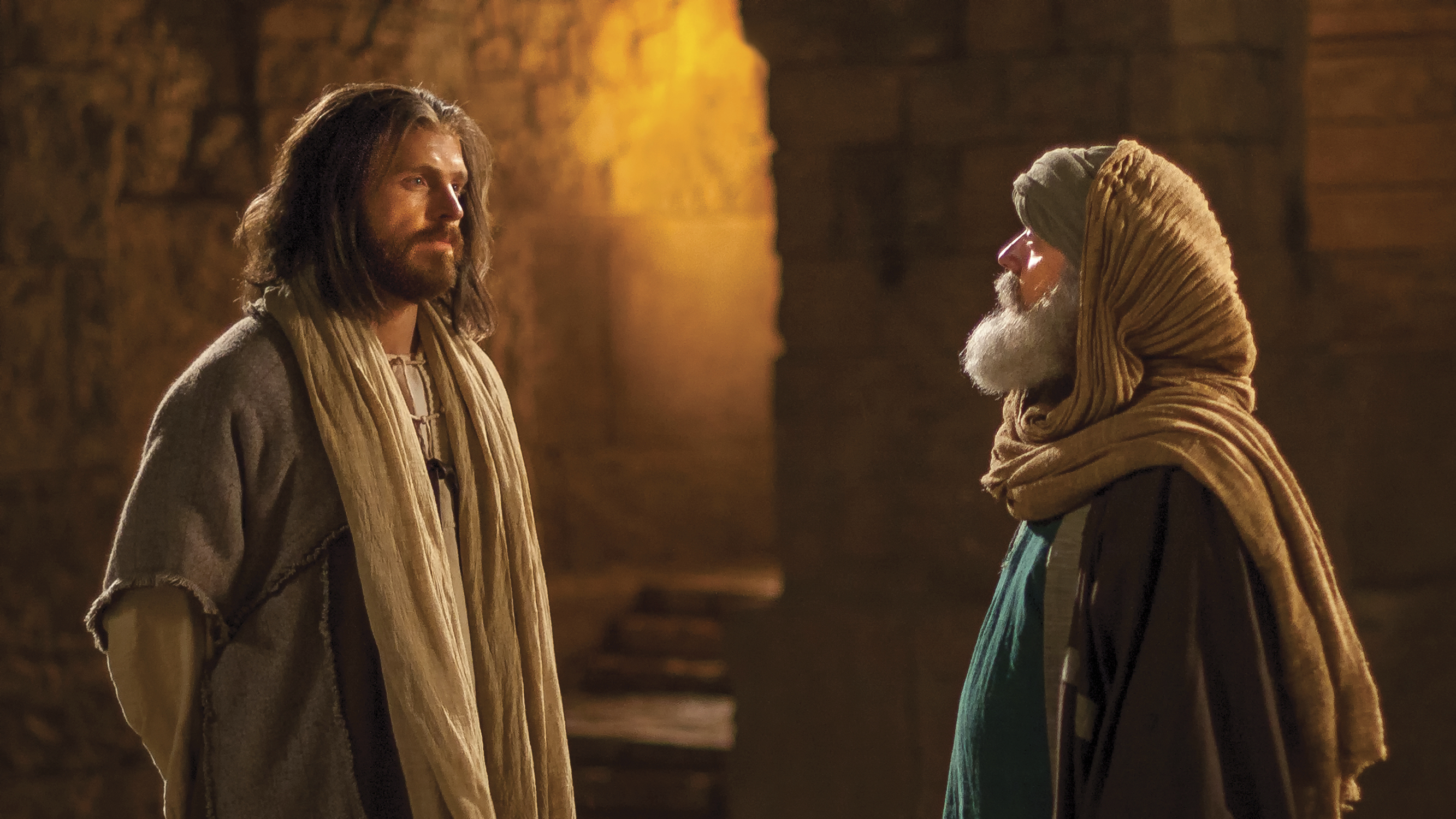
Fast forward to the Gospel of John and we encounter another person of faith, Nicodemus, who is both inquisitive as well as practical. He comes to Jesus under the cover of night. Why? Because he is a leader of the Jews, a member of the Sanhedrin, the supreme Jewish counsel, legislative body and judicial court—and, well…you know….people talk…and Nicodemus has a lot to lose. But Nicodemus is curious, and that curiosity overcomes the concerns he has about visiting Jesus. He comes to Jesus without even an opening question. He simply confesses his belief that Jesus’s teaching must come from God. And Jesus replies with a most enigmatic phrase: “Very truly, I tell you, no one can see the kingdom of God without being born from above.” Now, that’s about as clear as God’s travel directions to Abraham.
What each of these stories hold in common is this—they are about a journey, (one of the heart and the other of land). These are stories of faith, about the willingness to go where God calls us. Abraham was to travel to a new land that God would give him. Nicodemus was to discover the truth of the kingdom of God.
Here, in this passage from John, Jesus offers no practical guidance to Nicodemus. Nor does he offer the consolation of spiritual safety. In our Savior’s words there is no certainty. Jesus outlines a path of self-transformation full of risk whose only destination is love. “The wind blows where it chooses, he says, and you hear the sound of it, but you do not know where it comes from or where it goes. So it is with everyone who is born of the Spirit.”
And Nicodemus replies “How can these things be?” Notice, if you will, Nicodemus does not shut down, he does not close his ears, huff in disbelief and scuttle back into the shadows from whence he came. He engages. He, like Abraham, is curious—and maybe even hopeful.
Neither the story of Abraham nor Jesus’ encounter with Nicodemus offer us formulaic instructions as to how to get from point A to point B. What they do is this—they remind us that to engage in the pursuit of following God is itself to pursue mystery, it is to venture into the unknown. It is to learn to trust in the breath of the Holy Spirit—to set our sails in the direction of where the wind is blowing, and follow.
You may be wondering if Phil and my journey to Indianapolis with its inauspicious beginning ended with years of rancor and recrimination. Happily, it did not. We found a lovely apartment, good friends and made ourselves a home. It may not have been where I would have chosen to go—if given the chance to make an itinerary of my own—but it came with remarkable blessings that I couldn’t have imagined at the start of the journey.
The journey’s we take may be physical, moving from one place to another, or it they could be through the inner reaches of the heart. What we learn is that for Abraham, trusting God comes with the blessing of a family whose descendants include all those who have been baptized into the promises of God—including you and me. For Nicodemus, we see him twice more in the Gospel. First, speaking in defense of Jesus before the Sanhedrin who are wanting to arrest the Messiah, and again, at the burial of Jesus, where he assists Joseph of Arimathea in preparing Jesus’ body for burial. He has come out of the shadows, into the bright light of faith. Nicodemus’s journey took him perilous places—leading him to question his beliefs, at great social and religious cost, but finds its conclusion, ultimately, in the Garden of the Resurrection. For both Abraham and Nicodemus, theirs was a journey of trust, rewarded with the promise of God. I pray for the same for each of us. In Jesus’ name. Amen.