4 Lent.A.26
Samuel 16:1-13; John 9:1-41
The Rev. Melanie L. McCarley
Try as we may, we cannot always see the whole picture.
A story is told of the only survivor of a shipwreck, who washed up on a small uninhabited island. He prayed for God to rescue him, and for days upon days, he scanned the horizon for help, but he could see no one. Exhausted, he eventually manages to build a little hut out of driftwood to protect himself from the elements, and to store his few but precious belongings.
One day, after scavenging for food, this man arrives home to find his little hut in flames. Plumes of smoke are rolling up to the sky. He concludes, as might we all if we were standing in his shoes, that the worst has finally happened. Everything he has, has been lost. First, the man is stunned, then he’s angry. “God, how could you do this to me!” he laments. Exhausted, he falls asleep on the sand. Early the next day, however, he is awakened by the sound of a ship approaching the island. It had come to rescue him.
“How did you know I was here?” asked the weary man of his rescuers. “We saw your smoke signal in the sky, they replied.”
It’s a common mistake to assume that what we see is the limit of all there is.
With this in mind, let’s take a look at the reading from First Samuel. Here we learn that the prophet Samuel is called to anoint a new king to replace Saul, who has become a disappointment to the Lord. A little background is in order: In the preceding chapter, King Saul disobeys God’s instructions. Instead of destroying everything of the Amalekites, King Saul sees the opportunity for plunder and profit. So, it should not surprise us that God is no longer interested in a King who takes liberties in interpreting a clear command and rejects Saul as the King of Israel.
And the prophet Samuel is devastated. He (like all of Israel) had such hopes for Saul. The beginning of the lesson for today gives us a good picture of the state of Samuel’s heart. The Lord says to Samuel: “How long will you grieve over Saul? I have rejected him from being king over Israel. Fill your horn with oil and set out…”. Heavy of heart, Samuel does as the Lord God has directed him and arrives at the house of Jesse the Bethlehemite, where God assures his prophet that he will indeed find a suitable King among Jesse’s twelve sons. But here’s the thing—while Samuel sets out to do the will of the Lord, he brings with him all of his preconceptions about what this new king should look like—and are any of us surprised to discover that Samuel’s idea of a King looks remarkably like…Saul…who was tall, impressive, and Kingly looking. God knows this and says to Samuel: “Do not look on his appearance or on the height of his stature…for the Lord does not see as mortals see; they look on the outward appearance, but the Lord looks on the heart. And here we begin to see that this task of choosing a new king for Israel is as much a lesson for Samuel as it is for Jesse and his sons and all of Israel as well.
As son after son of Jesse passes before Samuel, we can imagine the prophet’s bewilderment and disappointment. Looking about, Samuel inquires if there are more sons of Jesse from whom to choose. And finally, the last son—the least of the sons of Jesse, appears…David, who will become the greatest King of Israel—though you wouldn’t know it by first glances.
The fact is, we don’t know the inner thoughts of Samuel. What we do see is this—that in spite of his grief, this prophet remains open to God’s direction. And therefore, he is open to new possibilities as well. In the end, Samuel’s example becomes a lesson for how we might deal with disaster, grief and disappointment when it comes our way.
With trust in God, we can see how grief and disaster can open possibilities we had not yet imagined. But this is hard, isn’t it. Like the Pharisees in today’s Gospel, so often we are determined to see things the way we believe they should be—and therefore we remain blind to the real work of the Almighty going on right before our eyes.
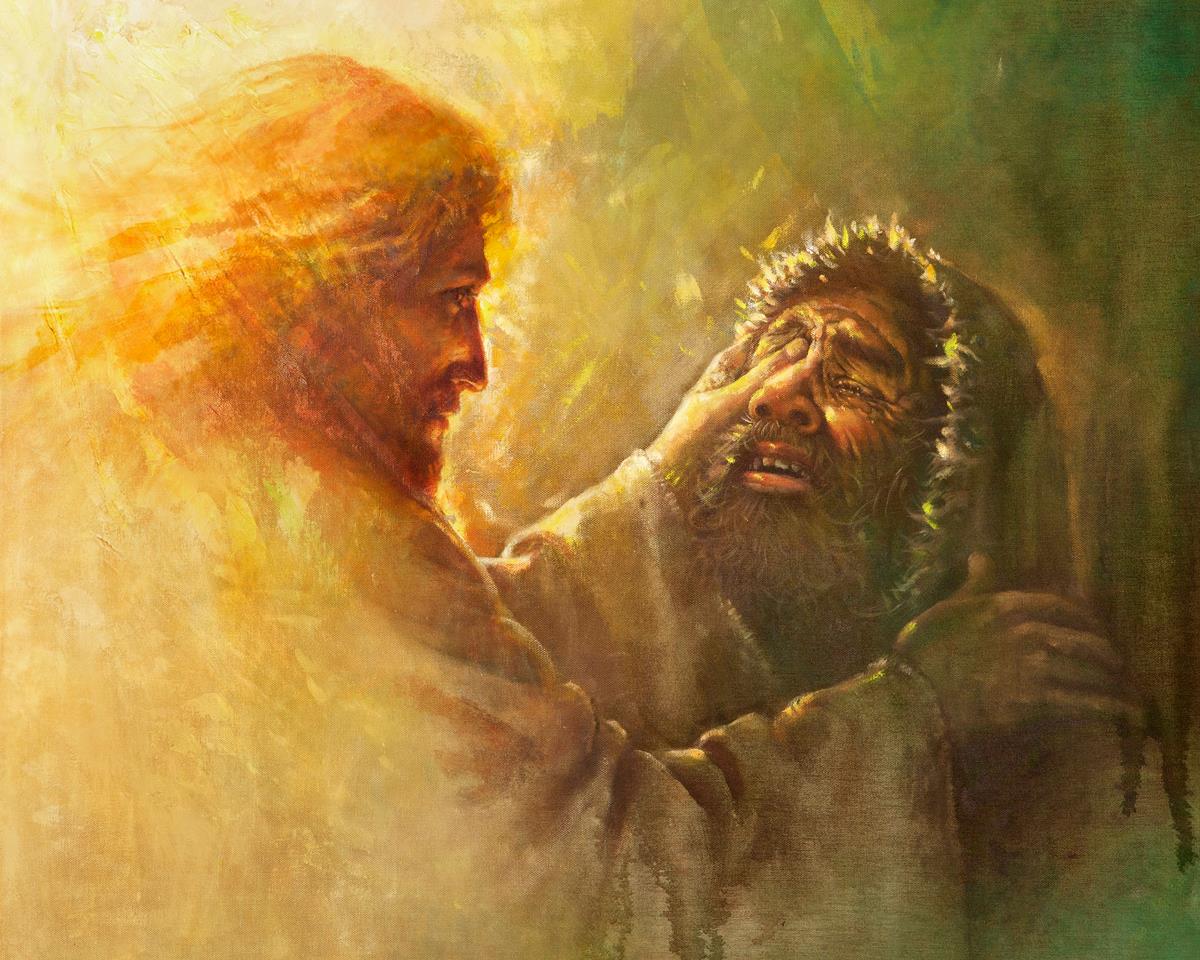
In the Gospel lesson for today we encounter a blind man, whose sight is restored. He recognizes Jesus—but the Pharisees, who had beheld this miracle for themselves, remained blind to the true nature of the Messiah. We are left with the conclusion that even those with twenty/twenty vision can fail to see what is right before their eyes.
I find myself wondering how many of us are held captive to our own expectations—believing that our perceptions are all there is to see? The house burns down, the leaders whom we have trusted disappoint us, the pink slip arrives, the bank forecloses, the doctors announce bad news—and we think this is all there is. Yet, if we were to pause, pray and look around, we might perceive that God is working, doing something new. Our hope, on this fourth Sunday of Lent, is to look to the horizon. God indeed sends us hope, in the person of Jesus. Not the Messiah that the world expects—but the Messiah which the world needs, one who saves us not by arriving as we might hope, leading the charge with a mighty army, poised to save us with tanks and missals, and other catastrophizing elements of war. God shows us another way. Jesus arrives at the gates to the city upon a donkey. What we behold is a man—only one man, the Son of God, betrayed by those closest to him, dressed in a mockery of a kingly outfit, a crown of thorns upon his head. He is not mighty, as we expect might to be. And, yet, his love for us is glorious. He is a Savior, but not one which we might design if given the opportunity, and certainly not one which the world would expect. His hands aren’t brandishing either a scepter nor a weapon, instead, they are outstretched upon the cross—a wide, saving embrace to save us all. He is far from what we expect, or perhaps have hoped for, but he is precisely what we need—our acceptance of this dependent only upon our willingness to see. In Jesus’ name. Amen.